Showing posts with label vintage jewelry. Show all posts

April 20, 2014

17 Ways To Wear a Vintage Dress Clip


Even a seasoned jewelry collector may ignore the vintage dress clip.  They seem like an anomaly.  How do you wear a dress clip, anyway?  Seems like only my grandmother would know.  After all, we don't see dress clips in modern design, so there's a mental block when it comes to using them.

1950s seashells dress clip and matching earrings.


But a dress clip is versatile, kind of like an earring that clips to a garment.  Usually women wore them (and still wear them!) at the V point of a neckline, or in the corners of a square neckline.  And here's a bigger variety of ways to use the "old-fashioned" dress clip:
  • Added to a chain as a pendant for a necklace
  • Worn on a hat
  • Closing a scarf
  • Tipping the point lapels of a collar
  • Clipped onto a pocket
  • Edging the hem of a pair of gloves
  • Made into a sweater clip by joining a chain between them
  • Instead of cufflinks for French cuffs
  • Holding a rolled-up sleeve in a loose cuff
  • Dressing up shoes instead of shoe clips
  • Clipped onto the flap of an envelope purse
  • Slipped onto a simple ring for a cocktail ring look
  • Altered into earrings by a jeweler
  • Converted into a pin by adding a safety pin inside a garment, with the pin's bar exposed to hold the clip
  • Flanking either side of a belt buckle
Antique style dress clips - only $10!


There's always a unique array of vintage dress clips on our website.  Now that you have a unique list of ways to wear them, include a dress clip in your next vintage-inspired outfit!

Opal lustre dress clip and matching earrings.


December 26, 2012

Jewelry in the Early 20th Century


1920s Egyptian Revival Necklace Set
1920s Egyptian Revival
From the Egyptian Revival jewels of the mid-1920s and early 1930s, to the gold chain necklaces of the 1940s, the fashioning of jewelry to accommodate modes of dress in the 20th century certainly mirrored political, social, and especially artistic trends. The excavation of Tutankhamun’s tomb in 1922 spurred the incorporation of Egyptian and stylized Oriental motifs in earrings, brooches, and necklaces. This exceptional necklace offers an idea of the exotic Egyptian-inspired works meant to grace the body with unique and eye-catching decorations. 

Miriam Haskell Pendant
The theme can also be observed in the following Miriam Haskell piece, which connects the 1940s draping gold chain motif design to a pharaoh’s mask and a carved scarab pendant. Fashions fluidly adapted to the times throughout the decades, and costume jewelry provided an affordable way to follow the changing styles when precious stones were not within one’s means. 

Edwardian Amethyst Glass
Another early 20th century movement which produced remarkably ornamented pieces of jewelry was Art Nouveau. The sensuous elements and the intense elaboration of the designs varied by country, yet the characteristics of the Art Nouveau style are unmistakable. Curls, coils, and romantic, symmetrically curved designs marked many of the unconventional necklaces, brooches, and pins produced throughout this period. Semi-precious stones also experienced popularity within the ornate designs. This was naturally dependent on consumer preferences and was also arguably proportionate to the growth of the Art Nouveau trend. The following two pieces demonstrate the primary facets of Art Nouveau’s signature distinctions. In the first, sinuous flowers and leaves connect to a lattice motif and frame a rectangular amethyst glass stone. The size of the pin suggests a versatility of use for a variety of dress styles and accessories. 

Edwardian Stone Trio Brooch
The second piece provides an example of three carved stones set within gracefully curving flowers and leaves. This intricate circular design rests on an ornate geometric background. The similarities and differences between these pieces illustrate the diversity of Art Nouveau jewelry.

Art Deco designs were also quite popular in the 1920s and 1930s, with their staged, geometrically sharp lines and the controlled, formalized motion of the jewelry’s focal point. Travel and exoticism were widespread themes for the designs, some of which included symbols of speed, transportation, and luxury, or alternatively, ancient historical motifs. ­ 

While this greyhound pin is from the 1960s/70s, the trend to use greyhounds or gazelles to signify fast and nimble animals dates to the 1930s. Pins and brooches in particular were produced to characterize the excitement of victory and speed on the racing track, often times with precious stones set within the geometric background. This motif is present on the rhinestone-studded blanket which has been placed on the greyhound’s sharply pronounced back.
Racing Greyhound

Brooches made in chrome and enamel, or plastic, were widely produced as well. In the United States, Art Deco jewelry was greatly shaped by Hollywood style, with artificial replacements for precious stones, and often restrained in color but glamorous in choice of background metal.

Although these artistic trends had unique characteristics, they continued to influence designs throughout the latter part of the 20th century. The rise of abstract, geometric patterns contributed to the emergence of a strikingly distinctive modernist style. Less ornate jewelry, with a more simplistic emphasis, became available in many materials, which provided increased accessibility to these trends for the general public. Modernist jewelry would come to be defined by soft abstraction, forgiving geometry, and understated sophistication. Perhaps this was an amalgam of complementary details, inherited from its diverse early roots. 

 -Blog post contributed by Ivayla Ivanova

April 01, 2012

April Showers Bring May Flowers

...and here's just the thing to ring in spring!


This charming set of scatter pins is a visual treat made just for this time of year.

What's a scatter pin, you say? It's a pair (or more) of pins that go together, and are worn 'scattered' over a blouse or sweater. Think Doris Day, sweater girls, mohair sweaters and such. Scatter pins were popular in the 1960s and are irresistibly wearable today.

We have a variety of scatter pins on our site at any given time. Take a look and snag a few - before they scatter like the wind!

May 30, 2011

A Vixen's Charm School Guide to Wearing Vintage Jewelry

Upon consulting our Charm School textbook (first published in 1962), we Vixens found a number of indispensable tips - and a few archaic ones - about how to wear vintage jewelry. According to the charm school headmistress:

  • Pearls are ideal for both day and night, and are quintessentially classic.
  • Bracelets that don't jangle are both understated and proper.
  • Earrings with a matching necklace "speaks of good taste".
  • Gold or silver bracelets can be worn in great quantity "if they fit you and the costume".
  • Rhinestones may only be worn after noon, if paired with a dressy outfit.
  • If purchasing an entire parure of rhinestones, wear only one or two at a time.
When selecting a necklace, keep in mind the length of your neck. The charm school says "A high choker, for example, is not for the woman with a short neck, for it tends to make the neck appear even shorter. A brooch or clips are more flattering ornaments in this case. But, if a necklace is really wanted, it should be long enough to fall well below the base of the throat".

And when shopping for earrings, "the woman with a large, round face should wear massive, bulky ear clips for better proportion. Little ones will look lost". For a long, narrow face, choose "ear clips triangular in sharp - with the base at the lowest part of the lobe and the point at the top" to create a "more becoming" oval appearance.

And for prettier hands, choose according to their shape as well:
  • Long and slim hands require a flexible mesh bracelet or several slender circlets. Rings should have stones with wide settings, as wide as the finger, and dark fingernail polish.
  • Large hands use wide rings best, or rings with high dome-shaped settings. "Wear a massive bracelet with high ornament, pushed up on arm" and dark or medium polish with clear moons & tips.
  • The slim little hand needs narrow bracelets and rings with gems set as rosettes.
  • And the broader hand can use substantial bracelets pushed up the arm to balance the proportion, with rings in elongated settings and light polish.


Resources:
Author Unknown (1969).
State College of Beauty Culture Guide to Beauty - Charm - Poise. New York: Milady Publishing Corp.

May 23, 2011

Shameless Plug: Vintage Jewelry

Okay, so I'm loving writing this blog, but I love shopping for vintage stuff even more than talking about it! And here's a few of this Vixen's favorite finds from our just-posted vintage jewelry collection:


This pin's one my favorites for its asymmetric grandeur. A smashing look from the 1950s!

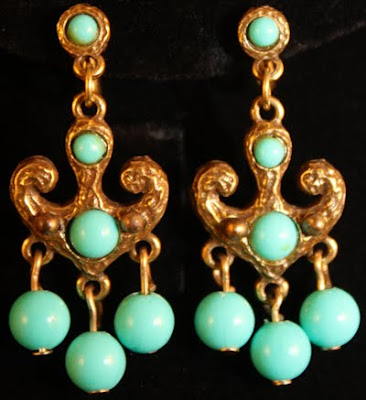
These are small earrings with spitfire attitude! A bit of bohemian gypsy meets "I Dream of Jeannie".

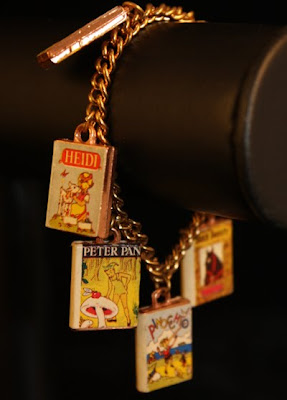
Quite literally a charmer! This bracelet is like out of a fairytale... and it's new-old stock, no less.

View all our jewelry
, and let us know your favorites! There's currently over 600 jewelry pieces to choose from on VintageVixen.com.